
In a world supposedly governed by ruthless survival of the fittest, why do we see acts of goodness in both animals and humans?
Aceasta intrebare este amplu dezbatuta de catre profesorul Lee Alan Dugatkin in lucrarea sa, discutata pe multe bloguri ...
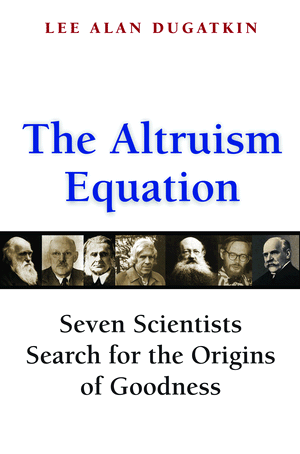
The Altruism Equation: Seven Scientists Search for the Origins of Goodness,
care ne prezinta ...
"The saga of man's quest to crack the mystery of altruism is a weird, uplifting, and sometimes tragic affair. Its heroes include a bearded Russian anarchist prince who thought mankind needed to learn a lesson from the animals; a bushy-browed loner who asked to be laid out in the Brazilian rainforest so that his body could be buried and then eaten by beetles; and the enigmatic suicide in a dingy London apartment of an atheist-chemist turned religious evolutionary mathematician."
cei 7 magnifici maniaci, fiind ...Charles Darwin, Walter Allee, T.H. Huxley, William Hamilton, Petr Kropotkin, George Price, and J.B.S. Haldane ...
Cine vrea sa-si cumpere cartea, sa si-o cumpere !
Pina atunci insa, recomand aceasta >>> recenzie ...
Aceasta intrebare este amplu dezbatuta de catre profesorul Lee Alan Dugatkin in lucrarea sa, discutata pe multe bloguri ...
The Altruism Equation: Seven Scientists Search for the Origins of Goodness,
care ne prezinta ...
"The saga of man's quest to crack the mystery of altruism is a weird, uplifting, and sometimes tragic affair. Its heroes include a bearded Russian anarchist prince who thought mankind needed to learn a lesson from the animals; a bushy-browed loner who asked to be laid out in the Brazilian rainforest so that his body could be buried and then eaten by beetles; and the enigmatic suicide in a dingy London apartment of an atheist-chemist turned religious evolutionary mathematician."
cei 7 magnifici maniaci, fiind ...Charles Darwin, Walter Allee, T.H. Huxley, William Hamilton, Petr Kropotkin, George Price, and J.B.S. Haldane ...
Cine vrea sa-si cumpere cartea, sa si-o cumpere !
Pina atunci insa, recomand aceasta >>> recenzie ...


9 comments:
(1)Darwin a ramas cam nedumerit despre altruism, el analizind societatea albinelor ...
raminind perplexat la faptul ca ca acolo doar Regina-mama se reproduce, ... pe cind restul sclavageste prin jur, unele o fertilizeaza, altele se sinucid, ... si toate astea sint facute cu un spirit de sacrificiu de o nobletze uimitoare ... Cum asa ??
Pai iac`asa! ca de fapt e din interes !! fiindca Regina-maman se reproduce nu doar pe ea, ci si pe ei, ... pe sclavi, pe trintori etc etc ...
DECI e vorba de:
... that "greater-goodism" , care e "Darwin's solution to the problem of selfless behavior in a competitive world"
(2)apoi a venit unul, Thomas Henry Huxley...
"who believed that human nature was fundamentally selfish, and needed the refinement of culture to lift it above the animal fray."
(3)apoi a venit barbosul anarhist Prince Kropotkin ... care a citit lucrarile lui (2) si a ramas totalmente indignat ...
fiindca:
"Wherever Kropotkin had looked in Siberia, he saw animals struggling together against the elements by sacrificing for each other and building societies of mutual aid. Wolves hunting in packs, horses forming defensive rings against predators, kittens huddling together to stay warm ..., all these made plain to Kropotkin what had escaped Malthus and Huxley and even Darwin himself: cooperation, not competition, was the rule of nature."
(4)In the 1920s in Chicago, a group of ecologists led by A. C. Allee and Alfred Emerson followed Kropotkin by emphasizing the struggle of organisms against their environments rather than against each other ...
"the ecologists from Chicago saw cooperation in nature rather than competition, discovering such surprises as "friendly" starfish and "loyal" sea urchins. Allee was a Quaker who sought to provide the scientific rationale for pacifism that Quakerism invited but lacked..."
Insa ei nu au stiut sa explice destul de convingator mecanismul natural al lui "feel-good theory"...
(5) ... "mecanism" care a aparut extrem de evident, dupa citeva halbe de bere ... unui geniu pehlivan ... "crouched over his beer in a London pub.
He was J. B. S. Haldane.
In the 1920s and 1930s, the Cambridge biochemist and mathematical geneticist's popular essays and books were widely read, and his Periclean speeches -- to the Royal Society, to Cambridge's iconoclastic Heretics Society, and in Hyde Park -- were famous.
He was a scientist, a philosopher, a writer, and a political speaker.
"I'd jump into the river to save two brothers and eight cousins," he is said to have slurred.
Here was the core idea: altruism was a function of genetic relatedness."
(6)apoi a aparut unul Bill Hamilton, ... a bushy-browed loner born in 1936 in Oaklea, Kent, just a four-mile walk from Darwin's old Down House...
animat de biologie dar si de matematica ...
"Spending lonely nights huddled on the benches of Waterloo Station scribbling equations, Hamilton desperately sought to solve nature's mystery of kindness."
si asa se facu ca a aparut eleganta ecuatie ...
r x b > c ... [the mathematical formulation of the idea that if the cost (c) of acting altruistically (measured in numbers of offspring the altruist loses by conferring help on another) was lower than the benefit (b) to the recipient of the altruistic act (again, measured in numbers of offspring) times the co-efficient of relatedness (r) of the two players (the probability that the two individuals both possess the gene in question), then genes for altruistic behavior could evolve].
(7)Intre timp, in America ... Meanwhile, in America, ... a disaffected former chemist turned science writer was breaking up with his religious wife. With the insurance money from a botched thyroid operation, George Price bought a ticket on the Queen Elizabeth and sailed to England.
There, he decided, he was going to help crack the problem of altruism.
Never mind that he had no statistical or biological education, nor institutional affiliation, nor any connections..., Price went straight to work. ...
In the end, hopeless, broke, and alone, he slit his throat and was found dead by the police on the linoleum floor of his decrepit London squat.
si acuma apare si unul care nu e mentionat in cartea lui Dugatkin, ...
(8)Robert Trivers, care nici macar nu era interesat in biologie, voia sa se faca lawyer, ...
"and it would take a tragic breakdown (a mania that took the form of staying up all night, night after night, reading Wittgenstein and finally collapsing)!!!!
(asta e ingrozitOOOr, si eu l-am citit obsesiv pe Wittgy !!!)
... to bring him closer to the animal world."
si studiind shopirlele, a ajuns in Jamaica ...
"When we flew to Jamaica," Trivers remembers, "I took one look at the women and one look at the island and decided to become a lizard man if that's what it took to go back there."
Thus was born the career of the man who would pretend to explain altruism.
si... Ia uitati-va ce frumos ...!
The theory of "reciprocal altruism" was modeled as the famous Prisoner's Dilemma,
and Trivers and others were able to show that repeated encounters between "players" would produce cooperative behavior, since in the long run this provided more gain.
Literally and logically, benevolence can be born of self-seeking: under the right circumstances, cooperation actually pays.
(QED chiar de magarushii de pe postare ...)
Draga Sehe, nu ne spui care este parerea ta personala, ca ce spun baietii astia am vazut.
Fiecare gand, orice ratiune descoperita prin grai de catre om il arata pe el insusi, nu neaparat explica o situatie data. Dupa mine exista "gena cumsecade" sau gena pozitiva, daca vrei, si cu ea ne nastem toti, pentru ca suntem chip si asemanare a Celui Perfect.
Sf. Simeon Noul Teolog explica legea data de Dumnezeu sub forma de porunca "iubeste pe aproapele tau ca pe tine insuti" tocmai ca pe un efort de a ne cauta si gasi noi insine in celalalt. Pentru ca nu am ales eu ca sa fiu eu, asa cum sunt, si puteam sa nu fiu eu, ci sa fiu tu. Iar tu sa fii eu. Asta este o privire foarte de departe catre judecatile Lui.
Teriile aste pur pragmatice, bazate pe observatii din istoria mai mult sau mai putin recenta, nu dau odihna. Mereu simtim ca nu am ajuns la capatul drumului cu explicatul, dar evitam cu dibacie sa ne infundam cu totul in ceea ce nu poate fi explicat. In mod curios, acel inexplicabil da odihna. briel
Post a Comment